Thursday, 2 February 2012

Your hopelessly late Doctor Who Season 6 round-up – The Doctor's Wife.


Never let it be said that I am not topical!

Firstly, a housekeeping point. I've turned on the log-in for leaving messages and feedback. I know its a ball-ache having to log in. But against that is the simple fact that it is impossible for me to tell one “anonymous” reply from another and I'd like to know who I am replying too! I can't be arsed with moderation though, so say what you like. If I don't like it I'll simply respect your opinion or tell you to eff-off or ignore you.

Let me continue by saying The Doctor's Wife left me with a problem. My normal “what I like” v “What I don't like” v “general comment” review was never going to be any good. I loved the episode and had little that was unique to say. Most of what could be said about the episode had been said by someone within 24 hours of broadcast. The “what I liked” would basically have consisted of me quoting about 80% of the script verbatim. The “what I didn't like” came down to the slight disappointment caused by the nondescript TARDIS corridors and the use of the RTD era control room rather than the Five Doctors to Survival era one. That was it, and even that was offset by the cool TARDIS grave yard, makeshift control room and the bliss of seeing proper old fashioned roundalls again.

It was only when I finished reading Michael Moorcock's “Coming of the Terraphiles” that I recognised a different way to consider the episode.

One thing that the episode absolutely isn't is a “Game Changer”. I think perhaps that everyone has realised that by now, but this was a common opinion at the time. The list of Game Changing stories is not a long one. By my reckoning the only true game changers are: “The Dalek Invasion of Earth”, “The Tenth Planet”, “The War Games”, “The Deadly Assassin” and “Rose” all of which reverberate throughout the following era's of the show.

The Doctor's Wife is actually an anniversary story in disguise. We come away feeling that we have learnt so much more than we actually have. The notion of the TARDIS as the Doctor's wife has been spoken of as being surprising. In reality it is completely obvious and has been explored and hinted at in the books, comics and audio's long before now. Similarly, the notion of the TARDIS being alive and in some sense sentient has been hinted at practically from An Unearthly Child onwards. That the TARDIS “stole” the Doctor is a new bit of history, but one which can be easily and logically inferred from the previous episodes. Was it really all that surprising to know that the TARDIS wants to see the universe too or that the Doctor was the only Time Lord made enough to go with her? Along the same lines, The Corsair's sex changing regenerations simply confirms what has long been speculated and again is a logical extension of a process known to allow for changing species (see Destiny of the Daleks, The TV Movie and iirc The Runaway Bride).

What the Doctor's Wife actually does is to consolidate and re-iterate the existing mythology of the show across all media and to flesh out long held fan theories. It is not so much an episode of the show as an episode about the show. It is does for “New Who” what the Five Doctors did for “classic who” albeit in the guise of a darker fairy tale. The hook here is that instead of seeing the Doctor interacting with himself, we finally see him interacting with the TARDIS in a way that is utterly appropriate and completely beautiful. Neither story does adds as much to the mythos as you first think, but both use the mythos to celebrate the show and ultimately confirm that the show is and always will be about a mad alien who stole a space time machine in order to travel the universe.

Neil Gaiman has always been one of the writers on the average Who fan's wishlist. He achieved much with this episode. It works as an accessible story in its own right far better than one could reasonable expect, it is a wonderful affirmation of the series and it somehow managed to meet or satisfy expectations even though we really weren't sure what to expect. Finally, it manages to feel like a typical Neil Gaiman story whilst also feeling like a Era Who story. The switch from series 5 to 6 actually helps out in that respect. Series 5 was an awkward hybrid of the Moff's Burton/Spielberg/Fairy Tale vibe and the RTD ear. Series 6 has definitely lost the RTD era tropes.

Michael Moorcock's Terraphiles is by contrast a case of a writer failing to meet expectations and putting a story out at just the wrong time. I'm not one for synopsis so the linkage for that is here: http://www.drwhoguide.com/whobb943.htm Note the cover its stunning.

Moorcock is another writer who has always had a significant following amongst Who fans and who also seemed to be a natural fit for a novel. The announcement that he was to write the first major Who hardback was greeted with almost universal praise and eager expectation. However, many of those voicing an opinion were simply conservative Who snobs who wanted “an established SF author” as opposed to a “fan writer”. Moorcock is obviously an SF powerhouse, but that very fact should have tipped people off that he was unlikely to be satisfied emulating some nebulous concept of “serious” or “proper” Who (Which almost always boils down to Dicks/Letts and Hichcliffe/Holmes). Those who are familiar with Moorcock's work also knew and realised that he writes in different flavours and voices, a literary David Bowie.

Terraphiles is very far from being “serious” who. It's so whimsical that it makes The Unicorn and the Wasp look like Cracker. It's basically a PG Woodhouse pastiche and has proven to be Marmite to the Who fanbase. It doesn't fit with the general feel of the Moffat era. The Doctor is generally well captured and feels like Matt Smith more and more as the book goes on. The characterisation of Amy is more hit an miss, but that's not surprising given the inconsistent writing for the character throughout season 5. A character needs to live and breath consistently on the show before a novelist can have any hope of capturing them.

Terraphiles is a story that would never go out on prime time BBC1. It could only ever be a novel and that's part of the appeal for me, especially some passages of quite beautiful prose which would only amount to some bog standard CGI on the telly. The books, audios and comics should do things that can't get on the TV, that's their greatest advantage. What is jarring is that this is the clash of Epic Cosmic Scale with twee Bertie Wooster – boys own story telling. This is not an entirely new approach to Who, Dave Stone has done much the same thing, albeit on a much less publicised scale. That the Beeb chose to Launch the “Guest Author hardback line” with what is essentially a Mash-Up is either a terrible false start or a confident and bold mission statement.

Ultimately, I am not sure anyone's expectations were really met. The book is too many things at once to be a classic Who story or a classic Moorcock story. But I don't accept that it is a failure in its own right either. I read it is four sittings and enjoyed all four sittings. On the other hand those four sittings were spread over several months so I can't claim the book is easy to pick up, only that once you have you will quickly get lost in it.

I started out by saying that Terraphiles was badly timed. It may have faired better if it had not been saddled with the expectation of being the first Guest Author hardback. It would have faired best if released in 1979. The Fourth Doctor and Roman flitting around space with a bunch of literary pastiches in search of an artifact which holds the universe in balance between chaos and order is just So Graham Williams.

Friday, 13 May 2011

Ignore All My Previous Theories AKA. Oh My God They Killed Rory (You Bastards) AKA They Keep Killing Rory

Well that was an enjoyable if thoroughly unambitious episode.

What I liked:

The Classic Series style of title.
Amy wielding a cutlass.
The Doctor starring across the dimensions.
A return to Horror of Fang Rock, Pyramids of Mars bloodbath style of plotting.
That the Siren was actually trying to help. This reminded me of optimistic tone of the first series.
Hugh Bonnerville was great raising the level of some rather dodgy writing in terms of his characters motivations.

What I didn't like:

Amy shouldn't have been anywhere near as effective a sword-fighter as she was even allowing that the Pirate's didn't want to be cut.

Everyone lived in the end. Would it have been so much to ask that some died as a result of botched attempts to save them

Rory. Dead. Again. What is the point. At this stage Rory has a better life to death ratio than Jesus and Buffy and is only slightly behind The Undertaker.


Other thoughts.

Interesting to see the online reaction. This seems to be the first episode since The Eleventh Hour where people have realised that the show under Moffatt has plot holes. My feeling on this is very much: Get Over It. The missing deaths of a couple of extra's is not a big deal.

Classic Who often had the problem of padding, not enough story to fit the allotted episodes. This means (arguably) fewer plot holes, but less entertainment. New Who has the opposite problem too little running time for the plots, which tends to result in "holes". As a rule I'll take fast past entertainment any day of the week. Of course, classic Who had stakes of plot holes anyway its just that the fans like to pretend otherwise.

I have had a problem with the Amy/Rory relationship since day one and its finally hit my what it is. I like the Doctor and Amy and I like the Doctor and Rory, but I don't quiet buy Amy and Rory as a married couple. This climax of this episode finally brought home why. There is very little in the way of casual affection between them. Only grand romantic gestures, Amy playing it cool and Rory being protective and insecure. The only exceptions I can think of are parts of Amy's choice and the Pond's at home sequence of The Impossible Astronaut.

Anyway Gaiman's episode is up next so all is cool.

Monday, 9 May 2011

Schrödinger's pregnancy

Well that certainly raised a hellavalot of questions.

It is now beyond any doubt that the upper boat team are taking a new approach to the series. This was very much reminiscent of the X-Files or The West Wing. A two part season opener which tells a mostly self contained story, but which also leaves intriguing threads to be developed as the season progresses.

What I Liked:

The whole opening "on the run" sequence and respective "escapes". The fact that the Doctor seems to have manipulated his captors into building a prison that he needs for his own purposes. Everyone writing on themselves to know that they have seen a silent. The Doctor manipulating the fuck out of the silence re-using the Remembrance of the Daleks gambit (trick the bad guys into killing themselves). River Song killing the fuck out of the silence. Spooky evil TARDIS. Amy in a haunted house (which was blatantly shot like the X-Files). Regenerating little girl (Holy Shit. OMFG etc etc). The Doctor's conversation with Rory.

What I did not like:

"3 months later", 3 days would've done the trick really. The "fell out of the sky line"; yes its a figure of speech, its also the very worst figure of speech you could use if your seeking to re-assure your insecure husband about an alien who fell out of the sky and into your life. Nixon; the River/Doctor conversation about him in the last episode (Some good stuff, Not enough) was about the best way of approaching him. Again, as with Churchill last year we get the Cartoon Historical version. Comparing these political figures with the portrayal of Vincent Van Gogh last year or Anthony Hopkins take on Nixon is like comparing a school boy five-a-side with the Champions League final. The difference really is that startling. To be fair the show was caught in something of a cleft stick here; Nixon was president at the time of the moon landings and a family sf fantasy show can't easily go into a debate on the merits of his presidency. But there was the option to exclude him from proceedings entirely or at least give him some more depth. The approach reaches its nadir when the "punchline" of Canton's homosexual relationship is revealed and played for laughs. The Doctor might have wanted to mention J. Edgar Hoovers proclivities here!


Other thoughts:

I think that Moffatt needs to re-consider the use of celebrity historicals. Twice now major figures have been shoe-horned into SF stories that Classic Who (or indeed the books or audios) would simply have told without.

The Doctor's "genocide" of the silence seems to have caused some ructions. On the one hand Mad Larry archly made the point that it was rather stupid for the silent to order the execution of his own species. This is frankly a case of stating the obvious and missing the point. Who Baddies boasting "you should kill us" is a trope of the series (see most recently the Silurian two parter for a very similar speech). Yes its stupid, but its clear from the episode the silent has been imprisoned for some time and that Canton has been trying to provoke just such a statement for some time. Moreover, if we are going to criticise this kind of plotting, then we may as well give everything in the show post An Unearthly Child a kicking because numerous enemies would have succeeded if they had (1) shut up and (2) killed the doctor rather than banging on about killing him. Moffatt is fully aware of this (Curse of the Fatal Death, I'll Explain Later).

There is also the "ethical" argument against this. I don't propose to spend too much time on this. Firstly, its clear that the Silence exist way beyond the human sphere of influence. I suspect if every human in every time on every world killed every silent they saw, there would still be plenty of them knocking about the universe. Secondly, humanity (and by extension the Doctor) are entitled to act in their own self defence and there is no other way for humanity to defend against the silence given that they can't remember them. Thirdly, contrary to what some would say, the Doctor has previous on this score (just off the top of my head: Macra, Daleks, Jaggaroth, Daleks again, Cybermen, Heamavores, Daleks again, Time Lords).

What was up with the Kid and the eye patch lady?

Wednesday, 27 April 2011

It really wasn't that complicated - a return to 4 part plotting

The Impossible Astronaut has made a splash with great ratings, audience share and AI, not to mention generally favourable reviews and Matt's wholly deserved BAFTA nomination. There seems to be some confusion as to what the plot actually was that I find rather baffling to be honest. I think that Who fans and TV fans in general have become accustomed to one episode storylines. In general even Who's two parters tend to comprise of episodes with their own individual beginning, middle and end. Hence they all (bar the End of Time) have individual episode titles.

This is a relatively new innovation for Doctor Who. For 26 years the TV show merrily spent three, four, 6 or more weeks developing the storyline. Can you really tell for instance what the plot of the say the Dalek Masterplan, Evil of the Daleks or the Curse of Fenric is or will be from part 1. By the time you get to the '90s and the New and Missing Adventures you have story's in which the plot is kept deliberately obtuse or non-linear simply to prevent the boredom of fans who already know the standard tropes and storylines.

Seen this way it should be appreciate that the episode is perhaps rather less confusing than some have suggested. Indeed it is not hard to state the plot:

1) Weird aliens (The Silence) have been on the Earth for a long time. They have built a massive network of underground tunnels using the "other" TARDIS. Nobody on Earth knows about this because The Silence have the ability to make sure that people forget them instantly.

2) The Doctor knows about The Silence. His future self has spent a couple of centuries running from something related to them (probably the knowledge of his own impending death) but he has now decided to face up to this.

3) Future Doctor calls Amy, River and Rory to a meeting to give them the information to get current doctor to America in 1969 (and probably to witness his own death, thereby hoping to retcon it). Future Doctor then dies.

All of this would be "Part 1" under the old 4 episode stories. Its basically setting the scene, but not actually moving the plot along much. Compare with, for instance, Planet of the Daleks wherein 25 minutes are spent wandering aimlessly around a jungle only to find (gasp) a Dalek*. We don't necessarily know the "Why" for a lot of the Future Doctor's actions, but we don't actually need to at this stage. It's not a plot hole, its a point to be developed later in the story.

4) Current Doctor goes to America as instructed and starts to investigate the silence.

5) Amy shoots what she thinks is the Astronaut who killed Future Doctor.

That is episode 2 of the old style structure of story. Nothing complex about that at all.

One review I read made the point that the episode felt very much like the first part of a season finale and that may well prove to be the most astute observation as the indications are that season 6 will be at least as intense and intricate as season 3 was. Looking back, The Impossible Astronaut matches the approach of The Pandorica Opens far more than The Eleventh Doctor (or perhaps more fairly Smith and Jones). New Who has generally applied the KISS principal for fear of alienating the general audience and Moffatt is to be commended for attempting a shake up, particularly at the start of the season.

Tuesday, 19 April 2011

"Don't forget me"

We never did and we never will. RIP Elizabeth Sladen, Sarah Jane Smith. Say hello to Jon, Ian and Nick from us Who fans.

Wednesday, 23 February 2011

Nick Courtney - RIP

Very sad to have come home from work to see that Nick Courtney, The Brig, has died. There will be countless obituaries and tributes over the web in the coming days from fans. Most will be able to provide a better description of the man and his achievements than I ever could.

I am however saddened by his death and I want to take the opportunity to pay my respects.

I never met Nick and I was not a child of the Pertwee era. But, one thing that is apparent is that the man and the character he portrayed are both revered in fandom.

By all accounts, indeed one might say be EVERY account, Nick was a thoroughly decent and humble man with a great sense of humour. He treated the show and its fans with nothing but respect. His colleagues loved him. Tom Baker has said that he agreed to play the Doctor again mainly because he wanted to work with Nick again. Sadly, the decline in Nick's health prevented that reunion from happening.

The real loss is to his family and friends, those who truly knew and loved the man. But it is a testament to his talent that every Who fan will know that they will not see the Brig in action again and that we will all feel genuinely bereaved because of that.

Wednesday, 29 December 2010

Doctor Who - A Christmas Carol

Who Stalwart Terrance Dicks used to say that all you need for a good Doctor Who story is a good original idea, but that the idea didn't have to be your good original idea. The Grand Moff has taken this fine tradition of getting stories off the back of a lorry and used it for this year's Christmas Special.

This was actually the first Christmas Special worthy of the name since Voyage of the Damned. The Next Doctor and The End of Time were regeneration specials far more than they were Christmas Specials. Like Voyage of the Damned it repeats the trick of "fit blonde singer as guest star" and as with Kylie, Katherine Jenkins does okay.

There's not a whole lot I can say about the plot itself other than the fact that the ending is a bit of a con. Fast forward another day and instead of a "happy" ending you've got a crotchety old man mourning over a dead welsh singer. I suspect that Kazran would've fallen into another bout of depression and bitterness. Speaking of Kazran, Michael Gambon was absolutely brilliant throughout. For my money the first person to steal the limelight from Matt Smith since he first Geronimoed onto our screens as the Doctor.

I really was taken with the idea of fish living in the atmosphere, a great little SF idea of the sort I could imagine cropping up in a Stephen Baxter book.

For my money The Chimes of Midnight still stands as the best overall Doctor Who Christmas story. But this was the best Doctor Who Christmas special to be shown on TV to date.

Saturday, 25 December 2010

One more thing


Fezzez are not cool. They are fucking awesome!

Friday, 24 December 2010

Doctor Who: The Pandorica Opens & The Big Bang

Meanwhile, in the Doctor Who production office:

Steven Moffat: "Hey guys. Do you remember when Russell did the finale where the Doctor does a big speech about not having a plan and then a secondary companion gets resurrected from the mind of the main companion?"

"Yeah"

SM: "And do you remember when Russell did a finale where the Daleks and the Cybermen teamed up and the Doctor and his companion got separated when a crack in the universe closed?"

"Yeah.

SM: "And do you remember when I did a story with wibbly wobbly timey-wimey stuff?"

"Yeah".

SM: "And do you remember when Russell did a finale where everything got put right by time being re-set?"

"Yeah".

SM: "And do you remember when I did that bit where the Doctor confronted the big bad by telling it to review its records?"

SM: "And do you remember when Russell did an episode where all the stars went out?"

"Yeah"

SM: "And am I right in thinking people love all that stuff?"

"Yeah"

SM: "And do you think people will remember all that stuff?"

"Dunnoh boss, Why?

SM: "I'm going to be using all of that stuff for this years finale".

Some might say that I am being a bit uncharitable. But I think most people would admit that season's five's final was at times, a tad derivative.

Towards the back end of RTDs run (Stolen Earth onwards) there was a definite impression that the team had started to run out of creative steam. On reflection a year or so on the Waters of Mars is an honourable exception but Stolen Earth, Journeys End, The Next Doctor, The Planet of the Dead and The End of Time all tend to rely on their presentation and sense of occasion to support underdeveloped plots and/or recycled ideas. This is not to say that they were bad, more that they were like having a meal comprised entirely of deserts, enjoyable but lacking in nourishment and substance.

The Moffat era was therefore an opportunity to try something new. A way for the show to resist the pressure to go "bigger" all the time and instead try "different". Prior to the launch of season 5 there was much talk of the show having a more fairytale feel to it. But in reality this simply meant a return to old style Who sleepy villages in place of the urban settings and style of the RTD era.

Stylistically this years finale does feel smaller than any finale since Army of Ghost/Doomsday with most of the first part taking place in or under stone henge and with a relatively limited cast too. The first part is certainly very focused and I loved the use of the Cyberman as a technological mummy. The use of the head as a glorified Cybermat was totally cool too. Rory's return was handled in an amusing way, but at this rate he has already been resurrected more times than Jesus and will presumably soon have had more resurrections than the Doctor has had regenerations. The twist of the Pandorica being a trap for the Doctor was genuinely good. I could've done without the "alliance" of enemies. The reality is that any one enemy could have set this trap. I'm also stumped as to what the couple of random Silurians and the alien from the Love and Monsters chase sequence were doing there. The Judoon works in the context of the reasons given for the alliance and also ties in quiet nicely with the events of the IDW comics.

Sadly the twist is almost immediately undermined in the second part by more Wibbly-Wobbly stuff. This resolution is both clever and funny, but also too easy for my liking.

Much the same could be said about the whole of the second part of this story. The idea of the TARDIS exploding a causing the end of the Universe is a little hard to swallow in so far as there must have been TARDIS destroyed prior to this one (accidents, time wars etc). But on the basis that reality has changed now the Time Lords have gone I can accept this. What is somewhat harder to accept is that a cube of less than 100 square meters could contain an imprint of the entire universe. That is some compression ratio! I would be half tempted to refer to the use of the Pandorica as a deux et machina but for the fact that all good fans know only RTD does D.E.M.s!

The bottom line was that this was a clever and entertaining finale full of "cool moments". It was however something of a greatest hits package and I can't help but wonder if the Grand Moff was playing it safe. I also found the story basically lacking in the heart that I have come to expect from the RTD finales, each of which was a game changer. Here the resolution truly was a reset button as in terms of character development we are back to the middle of the season. I also found the whole thing to be somewhat lacking in heart, something I have come to expect from my season finales (be they Doctor Who or otherwise).

To boil it down into numbers, a solid 4 start out of 5. Very good, but not great and not a classic.

Overall though season 5 ranks highly for me, but not as high as season 3 which remains one of the greatest seasons of tv full stop. I would like to see Moffat and co take more risks with season 6. RTD's era had a few duds, but in those first four years you could never criticise it for playing it safe or staying in a comfort zone.

Doctor Who: The Lodger

I'm cheating on this one folks. What with one thing and another I got somewhat derailed from finishing up my season 5 posts, so I had to watch this one again to refresh my memory. That being said my opinion has not really changed in any great respect.

A curious thing about this episode is that you would almost expect it to have been the episode written by Simon Nye. The storyline of the Doctor moving into a flat and striking up an Odd Couple style friendship with his flat-mate is not a million miles from Men Behaving Badly territory. Instead this is a Gareth Roberts episode, dramatising his own tenth Doctor comic strip of the same basic story. The episode is placed in the now traditional "Doctor-Lite" slot, but is actually Amy-lite and Doctor heavy. This is no bad thing as once again Matt Smith rules all as the Doctor. James Corden as Craig essentially takes Amy's place in the episode. I find Corden to be irritating in real life, but he works well here as an upmarket Smithy.

The episode is a strange hybrid of old and new who. This is really classic Yeti/Tooting Beck territory but this aspect is kept mostly in the background to allow the Doctor to spend an episode being a weird and funny matchmaker. I do wonder who was trying to build themselves a TARDIS and whether that will have any relevance to "The Silence" to come.

There's little more I can find to say about this one. What it amounts to is a reasonably successful attempt at doing a sit-com. Great fun, but ultimately inconsequential.

Monday, 30 August 2010

Blake's 7: Blake

WARNING: ABSOLUTELY FUCKING HUGE TREMENDOUS SPOILERS OF HIDEOUS RUIN IF YOU'VE NOT SEEN THIS EPISODE.

Blake's 7 is a strange series in many ways. Frequently camp as Christmas, yet often unremittingly grim. The show was created by Terry Nation, he of the Daleks and post apocalyptic Survivors series (as well as the jobbing writer for any number of other popular telefantasy shows). The series was conceived as "the dirty dozen in space", but is as much informed by Star Trek, Doctor Who, Survivors, 1984, the second world war, the cold war and any number of folk tales.

Consistently underfunded and under-appreciated by the BBC its production values made 70s era Who look like 90s era Trek. The directorial style in particular is generally bland and lacking in flair and ambition. The show borrowed heavily from the Doctor Who talent pool with Who stalwart Robert Holmes being a regular writer. The more important writer, perhaps more so than Nation himself in later years, was Chris Boucher.

When it was at its best the show was superlatively brilliant, taught edgy plots meeting cracking dialogue spoken by iconic and complex characters. At its worst it really is bad. There's not much in between to be fair, so you probably get a ration of 3 classics to 1 stinker and 1 average show. The bottom line is that you can't consider yourself a sci-fi or cult TV fan if you've not seen this series. The show was a key influence on genre classic Babylon 5 and the premise was basically lifted wholesale for the short-live (but brilliant) Firefly series. They are all out on DVD and they are routinely on offer too.

Anyway, the story so far (in very brief):

Season One: How the band gets together, takes control of the Liberator (the most powerful spaceship in the Galaxy) and starts to fight the Federation.

Season Two: Blake goes on the offensive against the Federation and plans to bring down its main control centre. The series ends with Blake joining forces with the federation to fight off an alien invasion from Andromeda.

Season Three: Blake and Jenna are gone and Avon finale gets to be in charge. The Federation is badly disabled. Avon and Friends explore the Galaxy a bit with only occasional confrontations with the Federation until the Season finale. Servelan (camp, transexual wannabe, dictator of the Federation) springs a trap on the crew. The Liberator is destroyed.

Season Four: Cally dies and Avon is never the same again. The Federation begins to massively and aggressively re-expend. Avon gets steadily more and more psychotic as EVERYTHING goes wrong for our band. He tries to organise a counter-federation of all the independent worlds only to be betrayed by the leading faction.

Before you go any further check out this EPIC fan made trailer: http://www.youtube.com/watch?v=8Q1KdNKwRK4

All of which takes us to the last ever episode.

BLAKE:


The story picks up from the events of Warlord, in which Avon had tried to build an alliance against the Federation. He was sold out and the location of his base was revealed to the Federation so he and the crew decide its time to get the fuck out of dodge. They leave the base blowing it up in the process, but Avon has a new plan.

As the episode title suggests the new plan involves Blake. Avon has used Orac to trace him and they have found him on a frontier world, Gauda Prime. Gauda Prime was a Wild West type planet run by crooks and murderers. Soolin was born their and saw her parent's killed. She is therefore none to pleased to hear from Avon that the thugs in charge of the planet are petitioning to join the Federation, thereby legitimising their rule over the planet and protecting their position in charge.

As they approach Gauda Prime the ship is attacked and everyone bar Tarrant beams off. Tarrant managers to crash land the Scorpio on the planet in a sequence that was ripped-off in Star Trek Generations:


Meanwhile Blake is posing on the planet as a bounty hunter. He uses himself as bait to track another bounty hunter, Arlen, with the intention of recruiting her to the cause.

Tarrant survives the crash and is rescued by Blake. Blake takes Tarrant back to his base on Gauda Prime and we find out that Jenna died in a blaze of glory.

Dayna, Soolin and Villa set up camp in an abandoned building. Villa leaves a fire going which allows a bounty ship and Avon to trace the site. Avon shoots the ship down and they follow Blake's ship back to his base.

This is when all hell breaks loose. Tarrant completely misunderstands Blake's intentions and believes he has sold them all out to the Federation. In actual fact it is Arlen that has sold them out. The episode reaches a bloody climax:


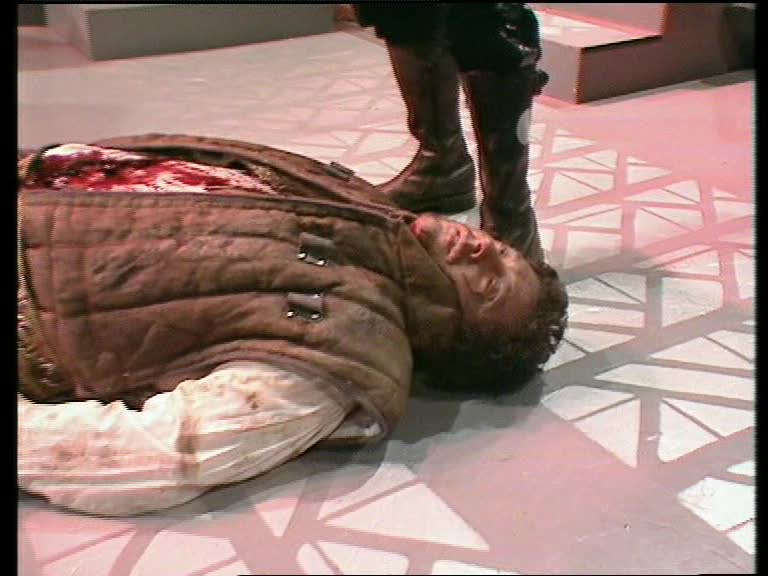
Avon asks "Have you betrayed us? Have you betrayed me?!". Blake's answer is fatal he says "I set all this up". Avon was totally batshit paranoid by this point having been screwed over several times in the last two years and he interprets these words as "I set YOU up". He shoots Blake and Blake dies in his arms:


his last words are "Avon".


Arlen gloats that Blake was right, he couldn't tell the Federation from the rebels any more:


and the bloodbath continues:


Dayna.


Villa.


Avon is oblivious, practically catatonic.


Soolin falls.


And finally, Tarrant.

The Federation Guard moves in on Avon:


And Avon takes his place standing over the fallen Blake:


The Camera cuts in:


And again:


And again:


And again:


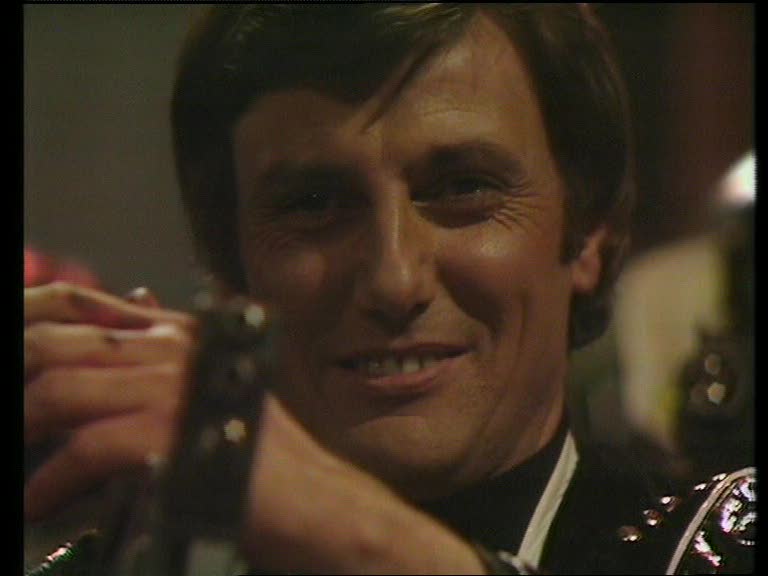
And Avon smiles one last crazed, ironic, nihilistic, smile:


The picture freezes, the credits hit and we hear the sound of multiple shots over the names "Avon" and "Paul Darrow":


Then the familiar theme tune begins:


And the series is no more.

This was not just the season finale, it was the last ever episode of the show. It went out a few days before Christmas thereby traumatising thousands of children. The irony is that Season 3 was supposed to be the final episode, but the series was recommissioned. Series 4 was not meant to be the final episode at all. Chris Boucher has planned to continue into series 5 with any of the cast that signed back on, but the continuity announcer stated that it was the last ever episode and that was that.

In my mind this is probably the best episode of the show. It is unremittingly bleak and nihilistic. Everyone we came to care about had died before the episode or during the episode. The Federation turn out to be the winners and probably stronger than they were at the start of the show. Our hero's lost big time. This is entirely apt. It was only realistic that the tactical advantages of two superior ships and one superior computer would ultimately be overcome by the might of an entire interstellar empire. Particularly as one as ruthless as the Federation was. Nevertheless, this sort of thing does not normally happen in tele-fantasy finales and would not have happened had the show gone to a fifth series as Boucher and Nation wanted.

One side affect of the curtailment of the series is that Jacqueline "Servelan" Pearce was not present for the finale. This was because she had already starred in her contracted number of episodes for that year. This was a sore point for her, although the writers have said that they had not deliberately set out to exclude her from the last ever episode. However, the absence of Servelan serves the episode well. Just as Blake could never bring himself to kill Travis directly, so Servelan could never quiet bring herself to dispose of Avon face-to-face. Arlen had no such compunctions and also lacked the camp factor of Servelan. The result is that the conclusion is played entirely straight and is extremely bleak.

Ever since the episode aired there have been numerous stories and theories put forward to continue the story and explain how one or more members of the crew could have survived. Boucher himself intended for Avon and Villa at least to survive. Nation tried to revive the series on the basis of Avon alone surviving in exile like a futuristic Napoleon. Years later "Blake's 7 Enterprises" attempted to use a similar idea to sell a continuation to Sky (don't even get me started on their incompetence). For me though I can't help but think that Blake's 7 is now a series that would better suit a "re-imagination" rather than a continuation, particularly since several cast members have been lost over the years.

On a personal note, I first saw this episode in 1994 when I was 14. I did not have access to the net or any episode guides, although I did know from Sky's pre-advertising that Blake was the last episode. I was fully expecting a rabbit out of a hat after the events of Warlord until there was about 10 minutes left and I realised that there was no way that Avon, Blake and Co were going to beat the Federation, even then I did not see the climax coming. When it did I was utterly shocked and I experienced exactly what the contemporary viewers must have felt. Years on this episode continue to hold considerable power and holds up to repeated re-viewings. Blake's 7 had a dozen or so episode that are classic SF stories and another twenty or so that hold up as being very good indeed. For me Blake is the greatest of them all. I have used the word nihilistic several times, but this episode could be the very definition of the word. Certainly no over drama I have seen can match Blake (Life on Mars final moments are the closest, but not in the same league at all). By circumstances of intention and accident it is a classic tragedy that could easily be performed (or "re-imagined") as a standalone story in any media with precious little alteration. It is a masterpiece.

Sunday, 29 August 2010

Vincent and the Doctor

Anyone who doesn't think that Doctor Who is one of the greatest shows on telly should have their telly confiscated.

I'll put my cards on the table. I have something of a weakness for Richard Curtis stuff (obv. not the Vicar of Dibley). Yes his stuff can be ridiculously middle-class and twee at its worst, but the guy did Not the Nine O Clock News, Blackadder and I Notting Hill, which I consider to be the finest fairy tale in living memory. So I was almost as pleased and surprised to read that he was doing Who as I was pleased to see that Gaiman was doing Who.

The title of the episode was clever in so far as we were all clearly meant to think "Ah this is the Celebrity Historical romp for this series". However, if anything that turned out to be Victory of the Daleks with its cartoon Churchill and Spitfires in space. This is far from a romp. It is however a wonderful character piece. I get the impression that Curtis has wanted to write this story for a while but lacked the vehicle to do so. The flexibility of Who's format allowed him to tell this story and get it on prime time TV. In some ways it reminds me of The Also People in so far as the plot and the monster is simply a reason for the characters to talk to each other. Indeed the use of the "invisible" (cheap) monster was the only thing that held the episode back. I get that the Kids probably expect a monster, but if you are barely going to show it on screen, why bother? Similarly I could have done without the Athlete track at the end. That felt like the Doctor Who confidential house style rubbing off on the parent series. It was over-egging the pudding.

Anyway these are minor flaws in what was an otherwise brilliant episode. A story of the Doctor and Amy given a deeply wounded man a few moments of joy and grace.

In many ways this was a return to the ethos of the Hartnell era. Taking the show back to the idea of following one man's travels through time and space. We need more episodes like that, they don't all have to be about the mosters of the good of the Doctor fighting the evil of the Baddy. We should have a few more bits of character based sightseeing.

Saturday, 28 August 2010

The Hungry Earth/Cold Blood

Way back in the pre season publicity there was a lot of talk of a new approach to Who, treating it as a modern day fairy tale. To a greater or lesser extent this approach was evident in the whole of the season. In the first episode we have the orphan girl who grows up in a spooky old house with a room nobody ever sees. In the second we have the space whale carrying the whole or Britain on its back. We have vampires and dream lords and even the Dalek episode has shades of the Tin Man/Pinnochio.

This story therefore strikes a discordant note being a love letter to the Pertwee era of the show. The choice or writer is equally discordant. Why Chris Chibnall was chosen to write this one is unclear to me. He is a competent writer, but one who seems to write to the level of the brief he is given. Its arguable that nothing improved Torchwood in season 3 so much as his absence from it. The first two seasons certainly varied wildly in tone and approach and at times in season 1 the show took a positively bizarre approach to its arc and character development eschewing the resent switch but similarly failing to deliver conclusions to any of the character's individual story arcs. On the other hand Chibnall's finale to season 2 worked as a neat conclusion and, by RTD's own admission, crystalised what the show would go on to be. Similarly I have always been rather fond of 42 and episode unfairly maligned because of Michelle Collins' performance.

Nevertheless it seems to me that this story would have been the perfect story for Mark Gatiss (far more so than the Dalek one). Gatiss already has already demonstrated the chops for such a tribute in his novel Last of the Gaderene and the 2 episode format would appear to be far more suited to his style of storytelling.

It was never entirely clear to me what the production team were trying to achieve in bringing back the Silurians. I can't see that they have a huge nostalgia factor for Joe Public. Their first appearance is highly regarded by fans of a certain age and a certain style of Doctor Who. Their second is almost universally reviled by all fans. Neither story were big hits with the viewing public of the time. They do not fit the mould of being a classic monster in the way the Daleks or the Cybermen or Master do. I don't even think they rate in terms of B divisions monsters like the Sontarans, Ice Warrior or Rani. Arguably, your average punter on the street would be more likely to remember "the one with the maggots" than "the one with the Cave Monsters" if asked to recall some classic monsters. Furthermore any attempt to trade of the nostalgia factor of the Silurians as monsters is completely undermined by their "re-imagining" as a Trek/B5 style alien. The originals may now look cheap (or more accurately DO now look cheap) but in some ways humans in rubber and a mask are better than humans in makeup. Similarly the original story presented us with "scientific", "political" and a "military" leaders. The implication of this story is that the Silurians have a caste system. Whilst this is a logical development from the earlier story, it is to my mind an unwanted formalisation of the society. Human governments tend also to be comprised of leaders of specific groups and interests, but that does not mean our society is comprised solely of those groups and interests. It seems to me that Who does Monsters and Aliens. The monsters are monolithic cultures and the aliens are multi-cultural. It is for this reason that, to my mind, the sea-devils were always the much better antagonists. Being much dumber than the Silurians they basically fall into the monolith monster category.

I take the point that the Silurians are intended to be a proper society and that they have a perfectly valid point of view and a perfectly legitimate aim in wanting the Earth back. This is all well and good in theory. In practice there is never enough complexity shown in the species for them to be a truly believable alien society (as opposed to a believable monster) and there's no way the show is ever going to feature an earth run or shared with the Silurians. Even the right on lefty New Adventures continuity didn't have that happen for another thousand years or so. The consequence of this is that the end of any Silurian story set in modern times is either (1) they all die, (2) they all go back into hibernation. Dramatically then they are a dead end of an antagonist. On top of that the comparatively luxurious length of the modern two parter is still shorter than a Pertwee (or Davision) four parter and is nowhere near long enough to offer an effective presentation of the Silurian culture or the ethical dilemma posed by the story. In view of this, again, I can't help but think the Sea-Devils would have served this story better (or even the Ice Warrior as our nearest solar neighbours).

On top of all this we have the bizarre ending. The decision to kill off Rory is another part of this story that baffles me. Was there anyone who saw it that wasn't expecting him to be revived in some SF fashion by the season finale? Dramatically it doesn't really take us anywhere. We already know from the previous episode that he DOES really mean something to Amy. It doesn't even have the fun and entertainment factor of Adric death. Even those that don't like the character don't loath him as much as Adric! It seems he dies only so he can be resurrected in an "unexpected" way so Steven Moffatt can show how "clever" he is.

So yeah, there's a lot in this one that doesn't sit well with me. That being said there were a good few things I did enjoy. On a purely superficially level the throwbacks to the Pertwee era were a nice change from the RTD era "London and soon the whole world will be in peril and its all on CNN and everyone knows about it" motif. Matt was great (again) as was Meera Syal. I was surprised by that to be honest. I fully expected a painful "ernest" and/or "I'm above this" turn from her akin to Keeley Hawes in season one of Ashes to Ashes (or indeed Meera herself in Jekyl) but she put in one of the best performances of any of the guests since the shows return. This was particularly impressive and creditable given some of the dialogue she was given. The design work for the underground Silurian base was wonderful too (and yes I know they went to the same place as the Doctor's Daughter and no I don't give a toss). Although the death of Rory may have been the nadir of the season, the moments in the TARDIS immediately after the death were beautifully written and acted.

I'm not usually one for ranking episodes on a scale. But overall I cannot recall a story that ever fit so comfortably at 6 out of 10. This was the epitome of average with a few great moments being weighed down by a total lack of original though, clear direction or consistent tone.

Thursday, 24 June 2010

Amy's Choice

Crickey I am behind on these! It's not for lack of enthusiasm either. Unless The Big Bang is a Big Flop this has been the best season of new who outside the perfection that is season 3.

This episode certainly had "Low-key" written all over it in the previous. I was basically anticipating a sub-star trek, Brannon Braga-esque "what's really real" type of story. Up to a point that is exactly what we got and yet I found that outside of the first ten minutes, this was something quiet new and different too. In some ways that's a typical pattern for New Who. In the writers tale RTD comments on one story (can't recall which one) and points out that for all the advance publicity, everything after the first ten minutes was unspoiled.

The rather basic SF "what's real and what's not" plot was at least given a clever twist by having all of it be not real. This at least would put it ahead of 7 years worth of Star Trek Voyager for a kick off. Fundamentally, the plot wasn't the point. It was instead merely the pre-text for some fantastic dialogue and even better exploration of our key characters.

It's perhaps not surprising that this had its funny moments given that Simon Nye was the writer. This was however a more bitter and introspective form of humour than we have seen in the show before. I loved the "Self-harm" and "goodmare" lines, but the greatest gags in the episode:

"If you had any more tawdry quirks, you could open a tawdry quirk shop! The madcap vehicle, the cockamamie hair, the clothes designed by a first year fashion student... I'm surprised you haven't got a little purple space dog, just to ram home what an intergalactic wag you are!"

takes on a new meaning when you discover that the Dream Lord is the Doctor's own internal commentary on himself. Yes kids we are in Timewyrm: Revelation territory, only this time the story takes places in the companions psyche as well as the good Doctors. The notion of the Dream Lord as being some kind of proto-valeyard is as tawdry as the aforesaid quirks. This is an old man's bitterness and self-loathing made manifest, not some black hatted continuity-wank, poor man's Master. The brilliance of the episode is such that the you have to connect the dots to realise this. The Doctor's rather glib admission that the Dream Lord was him comes half an episode after he states there's only one person who hates him as much as the Dream Lord. If there's a flaw at all in this its that reflection at the end to help out the slower viewers.

All of which brings us to the subject of the episodes' title. Amy had, to this point, felt lacking to me. Whether you like Rose, Martha or Donna (and I do) or not, the fact of it is that they started out as well fleshed out characters and continued to develop from there. RTD really beefed up the quality of writing for the companions even if this was sometimes achieved by reducing the emphasis on the Doctor at times. The writing for Amy has simply not been as strong. To some extent this is arguably inevitable with a new, practically unknown, lead actor taking on the role of the Doctor. Nevertheless it's noticable that Rose is out of character is The Empty Child/The Doctor Dances and Sidelined in the Girl in the Fireplace. Similarly Donna got stuck with a stock Trek storyline in Silence in the Library, albeit a particularly well executed one. It's clear that the Moff has a bigger interest in the Doctor than the companion. This has certainly been to eleven's benefit but poor Amy has seemed rather generic and surplus to requirements at time. This episode corrects that in a large way. The Doctor (or Simon Nye) forces the issue of her relationship with Rory with the effect that we get to see a lot more of what makes Amy tick.

I simply loved the scene with Rory dying and Amy begging the Doctor to bring him back, followed by her angry "Then what is the point of you". Again a mark of the brilliance of the episode that its followed by an even better scene with the Doctor agreeing to drive into the cottage. Again, its what isn't said here that's important. The Doctor may well have figured it all out by then and if so he has clearly helped Amy to make her choice. But equally, he may not have it figured out, in which case he is prepared to take the risk of dying for nothing other than making a gesture to his new best friend.

I can see why this episode won't be to everyone's taste. On an objective level I couldn't say its a classic like Human Nature/Family of Blood. But it provides the heart and soul for this season in the same way that Turn Left did for season 4 and I LOVED it to bits because of that.

Also the snowy TARDIS was gorgeous.

Wednesday, 19 May 2010

Vampires of Venice

Now here we have a really cool alliterative title, which is a CON. They aren't Vampires and they aren't of Venice! They are of an alien world and/or Croatia depending on your perspective!

Now here's a thing. Back in the RTD era, the Vampire's probably would have been just that. RTD had an actual werewolf and actual Witches for example. So I am rather vexed, I've been waiting for the new series to do proper Vampires. The show has a good little history with Vampires: State of Decay, Goth Opera, Blood Harvest, even Zagreus. Good proper Vampires are becoming a rare thing in this post-Twilight, twee bullshit, era.

That point aside, this is the very definition of a bog-standard Who run-around. In some ways its arguably the first time the show has attempted to do something so pedestrian since the relaunch in 2005.

What raises the episode above Victory of the Daleks is the character stuff between The Doctor, Amy and Rory. Everything about that felt natural and Amy now feels like a much more fully rounded character to me than she did previously.

Nothing spectacular, but watchable enough and still better than Victory of the Daleks, which remains the season lowlight so far.